
12 commonly used terms for instruments
01 Measurement point (primary point)
The point in the detection or control system that comes into direct contact with the process medium. Such as pressure tapping points in pressure detection systems, installation points for thermocouples and thermal resistors in temperature detection systems, etc. One point can be on the process pipeline or on the process equipment.
02 Primary component (source component)
Usually refers to instrument processing parts installed at a single point, such as pressure gauges in pressure detection systems, thermometer bosses in temperature measurement systems, etc.
03 Primary valve (pressure tapping valve)
Valves installed on a primary component, such as valves for pressure detection systems connected to pressure taps, valves connected to outlet pipes of orifice plates for positive and negative pressure chambers, etc.
04 Primary component (sensor)
Refers to components installed on site and in contact with process medium, such as thermocouples, thermal resistors, etc.
05 One time instrument
A type of on-site instrument refers to instruments installed on site and directly in contact with the process medium, such as spring tube pressure gauges, bimetallic thermometers, differential pressure transmitters, etc.
06 One calibration (individual calibration)
Calibration refers to the pre installation verification of instruments. According to the requirements of the "Code for Construction and Acceptance of Industrial Automation Instrumentation Engineering" (GBJ-86), each instrument should undergo calibration once in principle. The focus of calibration is to check the indication error and variation of the instrument, adjust the proportional degree, integration time, differentiation time error, control point deviation, balance degree, etc. of the instrument. Only instruments that meet the design or product manual requirements after one calibration can be installed to ensure the quality of the second calibration.
07 Secondary instrument
The general term for various instruments that indicate value signals that are not directly in contact with process medium. The input signal of secondary instruments is usually the standard signal converted by the transmitter. There are generally three types of standard signals received by secondary instruments: pneumatic signals; II type electric unit combination instrument signal; HI type electric unit combination instrument signal.
08 On site instruments
The general term for instruments installed on site, including all primary instruments and secondary instruments installed on site.
09 Secondary calibration (secondary joint calibration, system calibration)
After the on-site installation of the instrument, the control room piping and wiring are completed and verified, and the entire detection circuit or automatic control system is inspected. It is also a comprehensive verification before the instrument is delivered for formal use. The verification method usually involves adding a signal at the detection stage and carefully observing whether each instrument in the system is working within the allowable error range. If the error exceeds the allowable range and the cause cannot be identified, all instruments that make up the system must be re debugged.
10 Instrument processing parts
The general term for all metal and plastic machined parts used for instrument installation, which occupy a special position in instrument installation.
11 Flow chart with control points
A drawing that uses process detection and control system design symbols to describe the automation content of the production process. It specifies the installation location of the instruments in detail, is an important drawing for determining the primary point, is a comprehensive reflection of the self-control scheme and automation level, and is also the basis for self-control design, and provides reference for construction installation and production operations.
12 Commonly used instruments and control graphic symbols
According to the national industry standard HG20505-92 "Text Codes and Graphic Symbols for Process Detection and Control Systems", and referring to the national standard GB2625-81, the commonly used graphic and text codes for chemical automation are as follows.
Graphic Symbol
Measurement points (including detection components) are the starting points of connecting leads from process equipment or pipeline symbols to instrument circles, generally without specific graphic symbols.
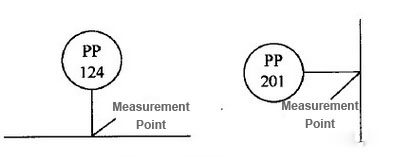
02
If the measuring point is located in the equipment, when it is necessary to mark the position of the measuring point in the process equipment, a small circle symbol with a diameter of 2mm or a dashed line can be added at the starting point of the lead.
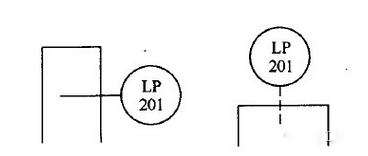
03
The graphical symbol of the connecting line is the lead wire connecting the instrument circle to the process measurement point. The universal symbols for instrument signal lines and energy lines are thin solid lines. When it is necessary to label energy categories, corresponding abbreviations can be used to indicate them above the energy line symbol. For example, AS-014 is a 0.14MPa air source, and ES-24DC is a 24V DC power supply.
04
When the universal instrument signal line is a thin solid line that may cause confusion, the universal signal line symbol can be added with a diagonal dash line on the thin solid line (the diagonal dash line forms a 45 ° angle with the thin solid line).

116 terms for industrial automation instruments
01
Process Measurementand Control Instrument
Also known as process measurementand control instrument. The general term for instruments used for detecting, displaying, controlling, and executing industrial processes.
02
Sensor
A primary component in a measurement chain that converts input variables into signals suitable for measurement.
03
Transducer
A device that accepts information formed by physical or chemical variables (input variables) and converts it into output variables of the same or different properties according to certain rules.
Note: There are various forms and names of measurement sensors based on the properties of the physical phenomena they rely on, such as temperature sensors, pressure sensors, and flow sensors
04
Transmitter
A measurement sensor that outputs standardized signals. For example: temperature transmitter, pressure transmitter, flow transmitter, etc.
05
Compensator
Compensation Element
A device designed to offset error sources caused by changes in prescribed working conditions.
06
Meter, Gauge
A device for measuring and indicating the measured value.
Note: Meters can only be used with modifiers, such as flow meters and pressure gauges.
07
Indicator
A device that provides visual indication of the measured variable.
08
Recorder
A device that records the relevant values of its input signal.
09
Multi Point Recorder
A recorder that records each input signal using a series of printed symbols organized by a printer.
10
Trend Recorder
According to the developed program or selected by the operator, a standardized signal recorder for multiple variables to be used together.
11
Differential Amplifier
An amplifier with two similar input lines that can respond to the difference between two voltages or two currents when connected to each other.
12
Operational Amplifier
A differential amplifier with high gain, high input impedance, and low output impedance.
13
Isolation Amplifier
An amplifier with no point connection between the input and output lines, as well as between the two lines and ground.
14
Total Instrument
The measuring instrument that determines the measured value by summing up the values of each part of the measured quantity. These partial values can be obtained simultaneously or sequentially from one or more sources.
15
Computing Device
A device or function capable of performing one or more calculations and/or logical operations, and outputting one or more calculated signals.
16
Feedback Controller
A device that can work automatically by comparing the value of the controlled variable with the value of the reference variable and changing the controlled variable to reduce the difference between the two.
17
Signal Selector/Auctioneering Device
A device that selects the expected signal from two or more input signals.
18
Automatic/Manual Station (A/M Station)
A device that allows process operators to switch between automatic and manual control, as well as manually control one or more terminal control components.
19
Manual Station,Remote Manual Loader
A device that only has manual operation output and is used to operate one or more remote instruments.
20
Alarm Unit
A device with audible and/or visual outputs to indicate that the equipment or control system is abnormal or exceeds its limit state.
21
Measurable Quantity
The attribute of a phenomenon, object, or substance that can be qualitatively distinguished and quantitatively determined.
22
Variable
A variable and usually measurable quantity or state.
23
Unit of Measurement
The specific quantity chosen to quantitatively represent quantities with the same dimension.
24
System of Units ( of Measurement )
A set of units established for a given quantity system. For example: International System of Units (SI); CGS unit system.
Note: The unit system includes a set of selected basic units and derived units determined by defined equations and scaling factors.
25
Value of A Quantity
A quantity represented by a number and an appropriate unit of measurement. For example: 5.3m; 12kg;- 40 ℃.
26
True Value
Strictly define the assumed theoretical values of variables.
Note:
(1) The true value of quantity is an ideal concept that is usually unknowable.
(2) What is actually used is the so-called 'agreed truth value'.
27
Conventional True Value
For a certain purpose, it can be used as a substitute for the true value.
Note: Generally speaking, the agreed truth value is considered very close to the truth value, and for certain purposes, the difference can be ignored.
28
Measurement
A set of operations aimed at determining a quantity.
29
Static Measurement
A measurement during which the value can be considered a constant quantity.
Note: The term 'static' applies to the measured object and not to the measurement method.
30
Dynamic Measurement
The measurement of the instantaneous or time-varying value of a variable.
Note: The term 'dynamic' applies to the measured object and not to the measurement method.
31
Measured Quantity
The measured quantity.
32
Measured Variable
The measured quantity, characteristic, or state.
Note: The measured variables are usually temperature, pressure, flow rate, velocity, etc.
33
Input Variable
Input variables into the instrument.
34
Output Variable
Variables output by instruments.
35
Measured Value
The quantity obtained based on the information obtained by the measuring device at a specified moment under specified conditions, and expressed in numbers and units of measurement.
36
Influence Quantity
A quantity that does not belong to the measured value but affects the measured value or the indicated value of the measuring instrument. For example: ambient temperature, frequency of the measured AC voltage.
37
Signal
A physical variable in which one or more parameters carry information about one or more variables represented by a signal.
38
Measurement Signal
A signal represented within a measurement system that is being measured.
39
Analogue Signal
Information parameters can be represented as signals of all values within a given range.
40
Digital Signal
Information parameters can be represented as signals of any value in a set of discrete values represented by numbers.
41
Standardized Signal
A signal with standardized upper and lower range values.
For example:
4mA~20mA (d.c.)
20 kPa~100kPa
42
Input Signal
The signal applied to the input of a device, component, or system.
43
Output Signal
A signal sent by a device, component, or system.
44
Quantified Signal
A signal with quantified information parameters.
45
Binary Signal
A quantized signal with only two values.
46
Result of A Measurement
The measured value obtained from measurement.
Note:
(1) When using the term 'measurement result', it should be clarified whether it is an indication, uncorrected result, or corrected result, and whether the average of several observations has been taken.
(2) The complete description of the measurement results should include information about the measurement uncertainty and information about the corresponding impact values.
47
Indication (of A Measuring Instrument )
The measured value provided by the measuring instrument.
48
Accuracy of Measurement
Synonym: Measurement accuracy, the degree of consistency between the measured result and the (agreed) true value.
49
Repeatability of Measurement
The degree of consistency between the results obtained from multiple consecutive measurements of the same object under the same measurement method, the same observer, the same measuring instrument, the same location, the same working conditions, and repeated conditions in a short period of time.
50
Error
The algebraic difference between the measured value and the true value of the measured variable.
Note:
(1) When the measured value is greater than the true value, the error is positive. Error=measured value - true value
(2) When listing errors on the data sheet of an instrument or device, the calibration method of the instrument or device must be specified.
51
Absolute Error
Subtract the measured (agreed) true value from the measurement result.
52
Relative Error
Absolute error divided by the measured (agreed) true value.
53
Random Error
During multiple measurements of the same object, its variation is an unpredictable part of the measurement error.
54
Systematic Error
The error in which the absolute value and sign remain unchanged or change according to a fixed pattern when measuring the same given quantity multiple times under the same conditions.
55
Correction
In order to obtain the corrected result, it is necessary to add the value obtained by algebraic method to the uncorrected measurement result, which is the opposite of the known part of the system error.
56
Correction Factor
The numerical factor multiplied by uncorrected measurement results to compensate for system errors.
57
Arithmetic Mean
The quotient obtained by dividing the algebraic sum of n measurements of a quantity by n.
58
Performance Characteristics
Under static or dynamic conditions or as a result of specific experiments, determine the relevant parameters and quantitative expressions of the function and capability of the device.
59
Reference Performance Characteristic
Performance characteristics obtained under reference working conditions.
60
Range
The numerical range defined by the upper and lower limits of the quantity being studied.
Note: The term 'scope' is usually accompanied by modifiers. For example, it can be applied to the measured variable or working conditions.
61
Measuring Range
The interval determined by the two measured values measured with the prescribed accuracy.
62
Measuring Range Lower Limit
The device can adjust to the lowest value of the measured variable and measure it with the specified accuracy.
63
measuring Range Higher Limit
The device can adjust to the highest value of the measured variable and measure it with the specified accuracy.
64
Span
The algebraic difference between the upper and lower limits of a given range. For example, when the range is from -20 ℃ to 100 ℃, the range is 120 ℃.
65
Scale
A set of ordered scale markings and all relevant numbers that form part of the indicator device.
66
Scale Range
The range defined by the starting and ending values of the scale.
67
Linear Scale
A scale in which the spacing between each grid and its corresponding grid value are in constant proportion.
Note: A linear scale with a constant grid spacing is called a regular scale.
68
Nonlinear Scale
A scale in which the spacing between each scale grid and its corresponding grid value are in a non proportional relationship.
Note: Some nonlinear scales have specific names, such as logarithmic scales and square law scales.
69
Zero of A Measuring Instrument
When any auxiliary energy required for the operation of the measuring instrument is turned on and the measured value is zero, the direct indication of the instrument.
70
Instrument Constant
To obtain the indication of the measuring instrument, a coefficient must be multiplied by the direct indication.
Note: When the direct indication is equal to the measured value, the constant of the measuring instrument is 1.
71
Characteristic Curve
A curve indicating the functional relationship between the steady-state value of an output variable of a system or device and an input variable, where all other input variables remain at a specified constant value.
Note: When treating other input variables as parameters, a set of characteristic curves can be obtained.
72
Adjustment
The operation of making the output of a device or instrument as consistent as possible with the expected specified characteristic curve.
73
Calibration
A set of operations that establish the relationship between the measured value and the corresponding output value of the device under specified conditions.
74
Calibration Curve
A curve that represents the relationship between the measured value and the corresponding value actually measured by the device under specified conditions.
75
Sensitivity
Divide the change in response of the measuring instrument by the corresponding change in excitation.
76
Accuracy
The degree of consistency between the measurement results and the measured (agreed) true value.
77
Accuracy Rating
The limit value of inaccuracy that can be guaranteed for a specific model of device in the specification.
78
Intrinsic Error
Also known as inherent error, the indication error of an instrument under reference conditions.
79
Conformity
The degree of agreement between the calibration curve and the specified characteristic curve (straight line, logarithmic curve, parabola, etc.).
80
Consistency Error
The absolute value of the maximum deviation between the calibration curve and the specified characteristic curve.
81
Linearity
The degree of conformity when the calibration curve approaches the specified straight line.
82
Linearity Error
The absolute value of the maximum deviation between the calibration curve and the specified straight line.
83
Dead Band
A finite numerical range in which changes in input variables do not cause any noticeable changes in output variables.
84
Stability
The ability of an instrument to maintain its performance characteristics unchanged for a specified period of time under specified working conditions.
85
Reliability
The ability of the device to complete the specified function under specified conditions and within the specified time.
86
Drift
Over a period of time, unwanted gradual changes in the input-output relationship of the device are not caused by external influences acting on the device.
87
Point Drift
The output variation corresponding to a constant input within a specified time under specified reference working conditions.
88
Zero drift
Zero drift, also known as point drift at the lower limit of the range. When the lower limit value is not zero, it is also called starting point drift.
89
Repeatability
The degree of mutual consistency between the output values of the instrument measured continuously in the same direction for the same input value under the same working conditions.
Note: Repeatability should not include hysteresis or drift.
90
Repeatability Error
The algebraic difference between the maximum values obtained from multiple consecutive measurements of the same input value in a short period of time when moving from the same direction in a full range under the same working conditions.
91
Span Error
The difference between the actual output range and the specified output range.
Note: Range error is usually expressed as a percentage of the specified output range.
92
Span Shift
Changes in output range caused by certain influences.
93
Zero Error
Under the specified usage conditions, the difference between the actual output value and the lowest value of the specified output range when the input is at the lower limit of the range.
Note: Zero point error is usually expressed as a percentage of the specified output range.
94
Zero Shift
The change in output value caused by certain influences when the input is at the lower limit of the range.
Note: Zero shift is usually expressed as a percentage of the specified output range.
95
Error of Indication
Subtract the measured (agreed) true value from the displayed value of the instrument.
96
Fiducial Error
The indication error of the instrument is divided by the specified value.Note: This specified value is often referred to as the reference value, for example, it can be the range or upper limit value of the instrument.
97
Mean Time Between Failures ( MTBF )
The average length of time between adjacent faults during the rated lifespan of a functional unit under specified conditions.
98
Mean Time To Repair ( MTTR )
The average time required for troubleshooting.
99
Failure
The termination of the ability of a functional unit to achieve its specified function.
100
Fault
An unexpected state that prevents a functional unit from achieving its specified function.
101
Fonction
The purpose or action accomplished by the device.
102
Sampling
The process of taking values from the measured data at certain time intervals.
103
Sampling Rate
The frequency of sampling the measured object, which is the number of samples per unit time.
104
Sampling Period
The interval time between secondary measurements in a periodic sampling control system.
105
Scan
Periodically sample several variables in a predetermined manner. The function of scanning devices is usually used to determine the state or value of variables.
106
Scan Rate
The access rate of a series of analog input channels, represented by the number of input channels per second.
107
Dead Time
Also known as death. The time from the moment when the input quantity changes to the moment when the instrument output quantity begins to change.
108
Time ConstantIn
a first-order linear system caused by step or pulse inputs, the time required to complete 63.2% of the total rise or fall of the output.
109
Damping
The dissipation of system energy during motion.
110
Periodic Damping, Underdamping
Also known as under damping, damping caused by overshoot in step response.
111
Aperiodic Damping, Overdamping
Also known as over damping. The step response does not exhibit overshoot damping.
112
Damping Factor
In the free oscillation of a second-order linear system, the ratio of the larger amplitude to the smaller amplitude of a pair of (opposite direction) continuous oscillations output near the final steady-state value.
113
Noise
A harmful disturbance that is superimposed on a signal, causing its components to be masked.
114
Input Impedance
Impedance between instrument input terminals.
115
Output Impedance
Impedance between the output terminals of the instrument.
116
Load Impedance
The total impedance of all devices and connecting wires connected to the instrument output terminal.
Reprint official account: coal chemical engineer
Mega-tek Instrument Classroom