
In the field of chemical engineering, level gauges are commonly used on various tanks. Below are two types of level gauges: radar level gauges and guided wave level gauges
Radar Level Gauge
Principle: Transmission reflection reception is the basic working principle of radar level gauges.
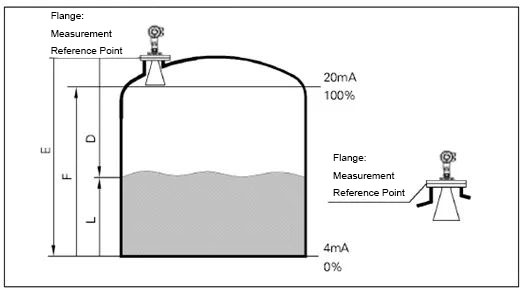
The antenna of a radar sensor emits electromagnetic wave signals in the form of a beam, which reflects off the surface of the measured material. The reflected echo signal is still received by the antenna.
Each point in the emitted and reflected beams is collected using ultrasonic sampling method. The signal is processed by an intelligent processor to obtain the distance between the medium and the probe, and sent to the terminal display for display, alarm, operation, etc.
Characteristics: The biggest feature of a radar level gauge is its significant effectiveness under harsh conditions. It can measure both toxic and corrosive medium, as well as solid, liquid, dust, and slurry medium. In terms of measurement, it has the following characteristics:
1. Continuous and accurate measurement
The probe of the radar level gauge is non-contact with the surface of the medium, which belongs to non-contact measurement and can accurately and quickly measure different medium. The probe is almost unaffected by temperature, pressure, gas, etc. (only 0.018% at 500 ℃ and 0.8% at 50 bar).
2. It has the function of suppressing interference echoes
3. Accurate, safe, and energy-saving
The chemical and mechanical properties of the materials used in the radar level gauge are quite stable, and the materials can be recycled, which is highly environmentally friendly.
4. No maintenance required and highly reliable
Microwaves are almost immune to interference and do not come into direct contact with the measuring medium, making them suitable for various applications such as vacuum measurement, liquid level measurement, or material level measurement. Due to the use of advanced materials, it is durable for extremely complex chemical and physical conditions, and can provide accurate, reliable, and long-term stable analog or digital level signals.
5. Easy maintenance and simple operation
The radar level gauge has fault alarm and self diagnostic functions. Analyze the fault based on the error codes prompted by the operation display module, promptly identify and eliminate the fault, make maintenance and calibration more convenient and accurate, and ensure the normal operation of the instrument.
6. Widely applicable, can measure almost all medium
In terms of the shape of the tank body, radar level gauges can measure the liquid level of spherical tanks, horizontal tanks, cylindrical tanks, cylindrical cone tanks, etc; In terms of tank function, it can measure the liquid level in storage tanks, buffer tanks, microwave tubes, and bypass tubes; From the perspective of the measured medium, it can measure liquids, particles, slurries, etc.
Summary:
Overall, radar level gauges have a wide range of applications and are non-contact measurement methods. Excellent material quality and low failure rate.
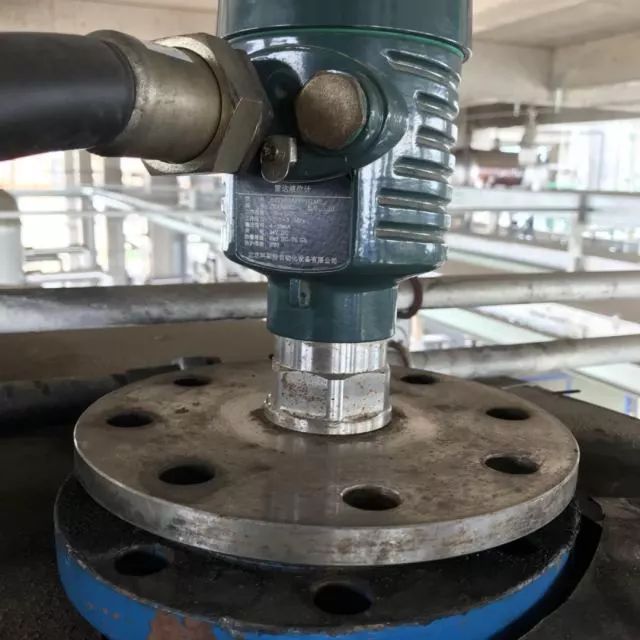
Guided Wave Radar
Principle: The guided wave radar level gauge is a measuring instrument based on the time travel principle. The radar wave travels at the speed of light, and the running time can be converted into a level signal through electronic components. The probe emits high-frequency pulses and propagates along the cable probe. When the pulse encounters the surface of the material, it is reflected back and received by the receiver inside the instrument, which converts the distance signal into a level signal.
Characteristics
1. It has strong inhibition ability to steam and foam, and the measurement is not affected;
2. Not affected by liquid density, looseness of solid materials, temperature, and dust during feeding;
3. Low maintenance, high performance, high precision, high reliability, long service life.
Is there any difference between them?
Different contact methods: Radar level gauges are non-contact, while waveguide level gauges are contact type. That is to say, in situations where food grade requirements are high, the pilot type cannot be used.
The working conditions are different: guided wave radar level gauges require more consideration of the corrosiveness and adhesion of the medium, and the installation and maintenance of excessively long guided wave radars are more difficult. Under low dielectric constant conditions, both radar and guided wave radar measurement principles are based on the difference in dielectric constant of the medium. As the waves emitted by ordinary radar are divergent, when the dielectric constant of the medium is too low, the signal is too weak and the measurement is unstable. In contrast, guided wave radar waves propagate along the waveguide rod, and the signal is relatively stable. In addition, general guided wave radar also has a bottom detection function, which can be corrected based on the measured value of the bottom echo signal to make the signal more stable and accurate.
There are different types of radar selection: ordinary radar can be interchangeable, while guided wave radar cannot be interchangeable due to the fixed length of the waveguide rod (cable) based on the original working conditions. Therefore, the selection of guided wave radar is more complicated than ordinary radar.
The measurement range is different: ordinary radar is more commonly used on tanks of 30 and 40 meters, and can even measure up to 60 meters. Guided wave radar also needs to consider the force situation of the guided wave rod (cable), and due to the force, the measurement distance of guided wave radar is generally not very long. However, in some special working conditions, guided wave radar has obvious advantages, such as mixing inside the tank and large fluctuations in the medium. In such working conditions, using a bottom fixed guided wave radar to measure values is more stable than using a flexible radar; There is also the level measurement inside the small tank. Due to the small installation measurement space (or the presence of many interfering objects inside the tank), ordinary radar is generally not suitable. At this time, the advantages of guided wave radar become apparent.
Reprint official account: Industrial Control E Station
Mega-tek Instrument Classroom